Sensing Heat in Karachi – A Photo Exploration


In Karachi, summer heat permeates the city's fabric and shapes seasonal urban environmental inequalities, leaving its residents gasping on scorching days. This visual blog captures daily life amid the heat in Karachi’s historic neighborhood of Saddar and at the Karachi Cantonment Railway Station. It explores how some marginalized residents in the urban global South navigate everyday heat and how their daily lives unfold through thermal rhythms. The aim is to expand the anthropological possibilities of studying heat beyond theoretical approaches rooted in climate science. This requires a nuanced understanding of the thermal practices of ordinary urban citizens – thermal cultures embedded in the deeper histories of the South Asian region, as seen in the ways people have historically related to and managed heat. (Lyu et al., 2023). I ask what kinds of thermal practices prevail, particularly for those who spend their days outdoors, recognising these experiences as part of the everyday 'thermal cultures' of social reproduction that sustain life and bodies (Doshi, 2017).
To explore city's heat through the materiality of human bodies and the urban environment; I took a visual journey from the crowded streets and markets of Saddar into the Karachi Cantonment Railway Station to observe urban residents' experiences. As the principal and busiest railway station in Karachi, this site exemplifies the interaction between weather and the city’s-built environment.
Karachi's characteristically high humidity and temperature variations lend themselves to thermal experiences widely recognized by its occupants, especially in its daily rhythms. As the temperature fluctuates from the preceding day, different time modes/slots occur; some are intense, while others are mild. Heat is articulated through rhythm to inform thinking about the temporalities of adaptation to extreme heat, how thermal rhythms are produced and experienced, and how these combine with various temporalities of work to shape patterns of heat exposure (Oppermann et al., 2020).
Two shopkeepers installing shade before the market gets crowded - Photo by KUL
I started my walk in the early hours of the day when spaces were less crowded. People prepared for the heat that would follow that day by setting up shade structures in front of shops and stalls, while others took their carts out to supply water and ice. I observed colorful umbrellas and assembled cotton sheets, forming material aspects of these thermal rhythms. As I walked along the city center, I often asked locals to direct me to the different types of shade. Navigating the heavily congested lanes, I wandered onto the pavement and repeatedly switched between the main road and cramped paths to jump between makeshift shaded patches and avoid heat.

Outside the market covered in fabric shades, I came across a vendor selling sugarcane juice on a cart, offering pre-emptive cooling to early-morning costumers. He started his day making a sale to a rickshaw driver sitting on the side of the road. His hands, stained from hours of labor the days before, grasped a long green stalk of sugarcane and positioned it at the mouth of a heavy iron press. He pushed the stalk into the machine’s metal rollers. The crank squeaked as he turns the handle, drawing the cane between the rollers, which crushed and ground it with a satisfying crunch. Pale green juice streamed out, flowing down a narrow spout, and was collected in a battered steel jug below. He repeated the process, sometimes feeding the same stalk twice to extract every drop. He dropped a chunk of ice into each glass, letting the juice froth as he pours, and handed it over. These early-morning noises and practices indicated the rhythm of preparing for a hot day, and the vendors’ stained hands revealed the repetitive nature of this process.
Sugarcane juice in the making – Photo by KUL
Karachi Cantonment Railway Station
When I reached the railway station at noon, it was quieter than expected. Since it was the occasion of Muharram, the number of passengers seemed unprecedented. As my team member prepared the camera, I stood beside her, and from a certain distance, I could see 'the coolies'. There was a moment when I paused to observe the anticipation on everyone’s faces and, with just a click of the camera, captured the transition from work to rest. The group of coolies (porters) paused in the shade on this hot afternoon. When air temperature matches or exceeds skin temperature, a body's ability to cool by radiating heat into the surrounding air diminishes (Schlichting, 2022). Avoiding sun exposure then becomes essential to prevent heat loss. Since body rest reduces metabolic rates and thus body temperature, these nappers kept as cool as possible. Evaporative cooling from the trees and the thermal properties of the underlying stone in the pavement supplemented the shaded relief for these coolies. This scene captured the rhythm mid-pause. The breezes in the vicinity, cutting through built structures on summer afternoons, further cool the resting men.

Further along, a man was sitting at the edge of the pavement with a water cooler, a few glasses, some lemons, and a lemon squeezer. At a certain distance, a lane of rickshaws was visible; some were dropping off passengers, while others were waiting for customers to arrive. He was selling nimbu pani (lemonade) as relief for the afternoon heat. Several coolies, workers, passengers came for nimbu pani to hydrate their bodies to endure sweltering heat. These transactions resonated my earlier sensory experiences with the sugarcane seller - a similar rhythm of thirst, relief, and return to labour, yet each vendor's setup and pace gave it a slightly different texture.
In the shade of a busy platform, a man serving the lemonade – Photo by KUL In the shade of a busy platform, a man serving the lemonade – Photo by KUL
At the end of the same lane, an RO water station had been installed by Saylani Welfare Trust, a non-governmental organization, offering another relief point for the afternoon heat. Two men were leaning against the water wall, seeking to find cooling. It was well-occupied, and many people were sitting around the refreshment spot. Outside of the photograph, elderly man was sitting alone on a bench, wearing a white kurta that seemed breathable, concerned about the choice of attire because of the heat. On a separate bench, a man was relaxing; he had kept his bag as a pillow to provide comfort to his head while resting. He was holding an Android phone in his hand and just scrolled through it. What the photograph could not fully capture was the texture of these overlapping rhythms, such as running water, drinking people, and resting men; bodies finding their way to endure the afternoon.

Saddar Market
Later that day, as the afternoon unfolded in the heart of Karachi’s bustling Saddar Market, a man sat on the pavement beside a mound of glistening ice blocks, partially covered with blue colored plastic wrap to protect them from the sunlight. The narrow pavement was crowded; shopkeepers called out to customers; the buzz of traffic and chatter fills the air. The vendor, dressed in a thin cotton attire, worked quickly, chipping shards of ice before threading a thin strip of cloth around each block, knotting it tightly to create a simple handle. This makeshift handle let the customer carry the slippery, dripping block with ease.
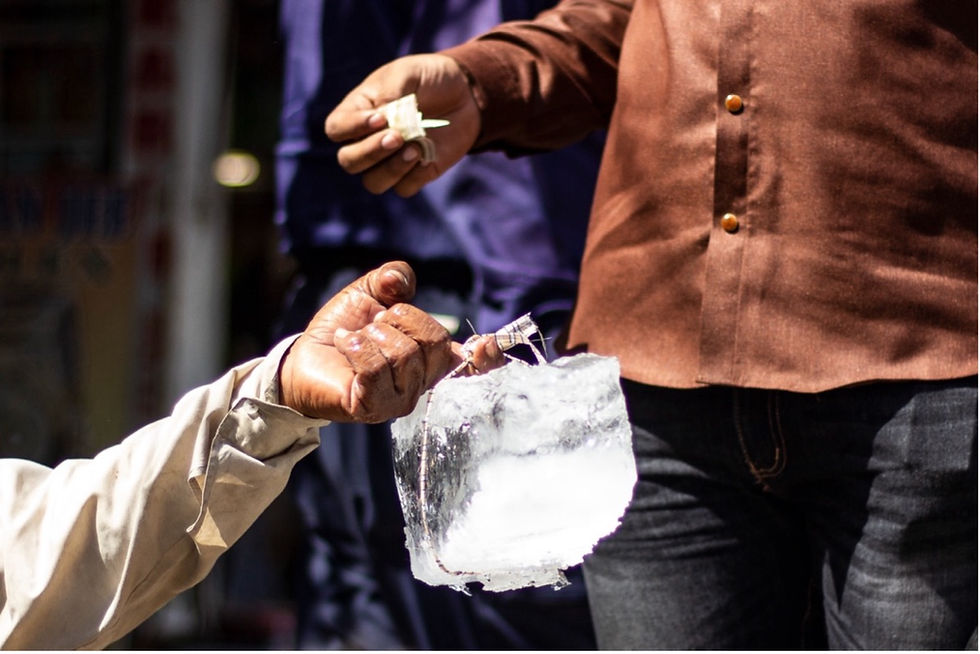
Around him, the city’s relentless heat was intense; children lingered in the hope of a stray ice chip, and the air was thick with a mix of humidity and anticipation. Each transaction offered a brief pause from the heat, a moment of relief punctuated by the sound of chipping ice and the slow drip of melt onto hot pavement. The sight of melting ice on a hot pavement captures the adaptive rhythms of Karachi’s urban life in summer.
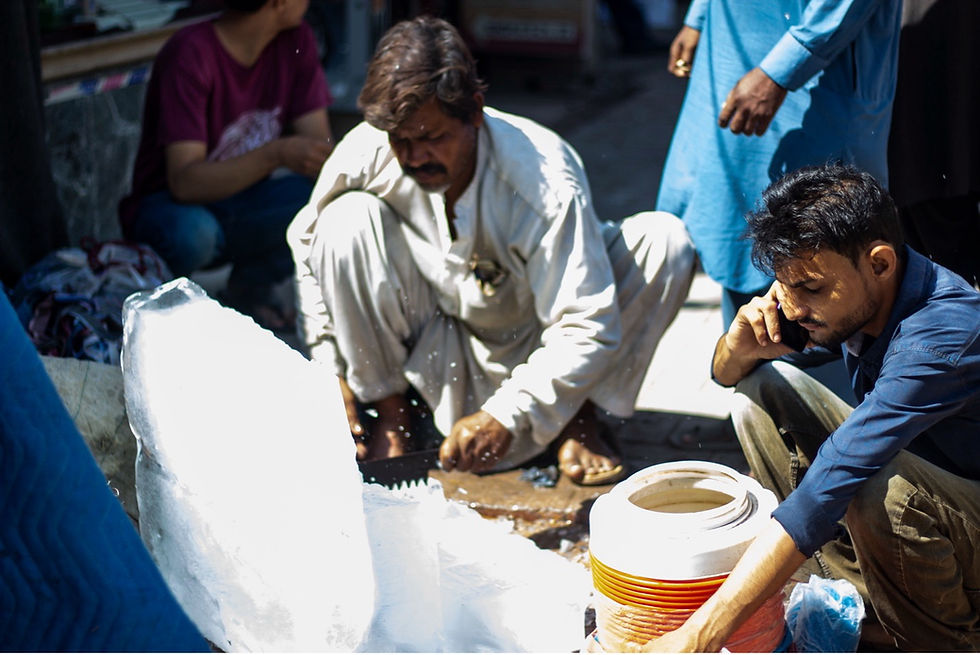
Nearby, a crowd had gathered around an ice stall in the densely populated commercial area of Saddar in the overheated city. The image's focus suggests the brightness of an unrelenting sun, even in partial shade. The sunlight penetrated the ice, reached the water cooler and hit one of the customers. Most of them were shopkeepers from the market. They were purchasing ice, and the anonymity of men, seen from the back or side, their faces partially obscured, universalized their experience. The bystanders on the pavement were wiping their foreheads, signaling the "hot day."
A customer walks away with ice in a plastic bag – Photo by KUL
Later in the afternoon, I lumbered along the roadside under the scorching sun and arrived at a construction site, where men were working in the scorching sun. Workers occupied the foreground, pushing or pulling a wooden handcart, leaning forward, and both arms and hands visibly engaged in the physical task. They wore loose, worn-looking blue-grey kurtas and light-colored trousers – a material dusty and drenched in perspiration - to navigate these demanding rhythms. Behind them were large, multi-story buildings representing a very different form of labor, capital, and urban development. The immediate surroundings contain piles of sand or construction material, dust, discarded material, and heavy urban infrastructure. A single tree in the upper left of the frame offers a gesture towards shade, but the workers are not in it. The photograph captures not just a moment of physical effort but a rhythm of cumulative and daily exposure.
A customer walks away with ice in a plastic bag – Photo by KUL
Walking through Karachi with a camera made the thermal cultures, bodily adaptations, and daily rhythms visible through which marginalised residents navigate an increasingly hot city. Defining thermal experiences through photographs allowed me to explore variations, from the early-morning quiet of a sugarcane vendor to the accumulated exhaustion of construction workers at dusk, in thermal experiences across the city. It also created opportunities for further inquiry, as heat is a heightened discourse of our time around climate change and how it alters lived spaces and their relationship with their surroundings. The focus on the visual serves not merely as an initial step but as a potential practice for curating the changing climatic landscape of Karachi, and how it is perceived and adapted to variation, thereby building an understanding of heat as more than a biophysical and environmental phenomenon, emphasizing its role as an embodied process (Smith et al., 2022). Each photograph captures a moment within a broader thermal rhythm, including aspects of endurance, coping, adaptation and improvisation.

References
Boni, Z., Bieńkowska, Z., Jancewicz, B., Wrotek, M., & Serrano, P. Y. (2025). ‘I felt I was melting ‘: Embodying climate change through urban heat. Geoforum, 164, 104330.
Doshi, S. (2017). Embodied urban political ecology: Five propositions. Area, 49(1), 125-128.
Lyu, K., Brambilla, A., Globa, A., & Dear, R. J. (2023). A socio-cultural perspective to semi-outdoor thermal experience and restorative benefits–Comparison between Chinese and Australian cultural groups. Building and environment,, 243(110622).
Oppermann, E., Walker, G., & Brearley, M. (2020). Assembling a thermal rhythmanalysis: Energetic flows, heat stress and polyrhythmic interactions in the context of climate change. GeoForum, 108, 275-285.
Schlichting, K. M. (2022). Hot Town: Sensing Heat in Summertime Manhattan. Environmental History, 27(2), 354-368.


Comments