Why Is Heat Less Prioritized in Low-Income Communities?

Heat is often presented as a standalone climate issue. But for residents of low-income settlements worldwide, it is inseparable from economic stress, social inequality, and inadequate services (Hosseinzadehtalaei et al., 2025).
During my fieldwork in 2024 in low-income settlements, including the Korail slum in Dhaka, I asked people about heat; the response was often laughter. “Why are you asking about heat?” they ask. “Are you serious? We do not have food to eat. Food produces heat. We do not even have food in our stomachs, and you are asking about heat?”
At first, this reaction can feel like a rejection of my question itself. But over time, I realized it is not a dismissal of heat as a problem; rather, it reflects how people experience risk and urgency in their everyday lives.
For residents of low-income settlements, daily life is structured around immediate survival. Income insecurity, food affordability, healthcare costs, housing precarity, water shortages, and debt dominate conversations. These are not abstract concerns; they determine whether a family eats today, whether children can go to school, or whether rent can be paid at the end of the month.
Heat, by contrast, is often perceived as something unavoidable, something that has “always been there.” When everything feels urgent, heat does not stand out as a separate crisis. It is folded into daily hardship rather than recognized as a distinct issue. This does not mean heat is not harmful. It means other problems accompany heat stress as well.
In Korail, heat affects income when people cannot work long hours outdoors or in poorly ventilated indoor spaces. It affects food security when cooking becomes unbearable or when people skip meals to avoid generating heat. It affects health when dehydration, exhaustion, and heat-related illness go untreated because healthcare is unaffordable or inaccessible. It affects housing when tin roofs trap heat and when electricity and water supplies are intermittent (Sultana et al., 2025). Yet when I ask, “What are the consequences of extreme heat?”, the answer is often silence or laughter. Why is this the case? Because heat does not arrive alone. It amplifies existing vulnerabilities. The laughter is not mockery; it is a coping mechanism.

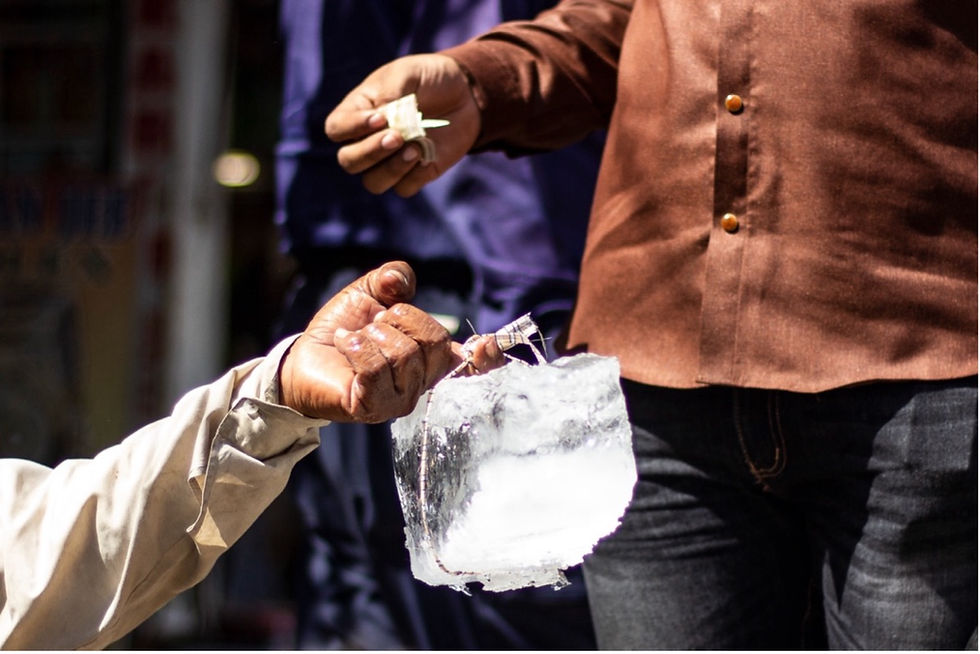
An individual hydrating with cool drinking water purchased from a shop during hot summer.
When people face layered crises every day, prioritizing heat can feel almost ironic. For someone worrying about tomorrow’s income or tonight’s meal, heat feels like a secondary concern, or even a luxury topic. This reveals an essential gap between how researchers and policymakers frame heat and how communities live it.
When heat is governed in isolation, interventions often miss the mark. Cooling centers, heat warnings, or awareness campaigns may exist, but they do little for people who cannot stop working, cannot afford electricity, or cannot access public facilities. Why is it rarely prioritized at the community level? Not because it does not matter, but because it is embedded within broader struggles. If heat adaptation strategies do not address income security, housing conditions, access to water, healthcare, and energy, they risk becoming irrelevant to those most affected.
If we want heat stress to be taken seriously, we must connect it to what communities already care about. Heat adaptation should be framed as a livelihood issue, because heat reduces work capacity and income; a health issue, because it worsens existing illnesses and exhaustion; a housing issue, because poor construction traps heat; and an equity issue, because those with fewer resources suffer more. When heat is connected to daily necessities, including food, work, shelter, and dignity, it stops being an abstract climate problem and becomes a lived reality (Sultana et al., 2025).
The most important lesson from places like Korail is that we need to recognize heat as part of everyday life, not a separate crisis competing for attention. Heat is not prioritized in low-income settlements because it is woven into everything else (IPCC, 2022).
To understand heat vulnerability, we must first understand poverty, informality, and survival. Only when heat adaptation is connected to people’s lived struggles, i.e., income, food, housing, and health, will it stop being something people laugh about and start being something they can act on.
Ultimately, heat adaptation will only matter when it speaks to people’s everyday struggles, when addressing heat also means protecting livelihoods, health, housing, and dignity, rather than treating heat as a distant or competing climate concern.
References
Hosseinzadehtalaei, P., Hamdi, R., Moradkhani, H., Termonia, P., & Tabari, H. (2025). Inequality in human exposure to future climate extremes. Nature communications, 16(1), 8058.
Intergovernmental Panel on Climate Change. (2022). Climate change 2022: Impacts, adaptation and vulnerability. Summary volume. IPCC. https://www.ipcc.ch/report/ar6/wg2/downloads/report/IPCC_AR6_WGII_SummaryVolume.pdf
Sultana, Z., Mees, H. L. P., Mallick, B., Driessen, P. P. J., & Bailey, A. (2025a). Rising temperatures, rising vulnerabilities: Individual and community adaptation to heat stress in urban slums of Bangladesh. Sustainable Cities and Society. https://doi.org/10.1016/j.scs.2025.106803
Sultana, Z., Mees, H. L. P., Mallick, B., Driessen, P. P. J., & Bailey, A. (2025b). Everyone's Adaptation: Exploring individual heat stress adaptation. Climate Risk Management. https://doi.org/10.1016/j.crm.2025.100269


Comments